


X
- No products in the list
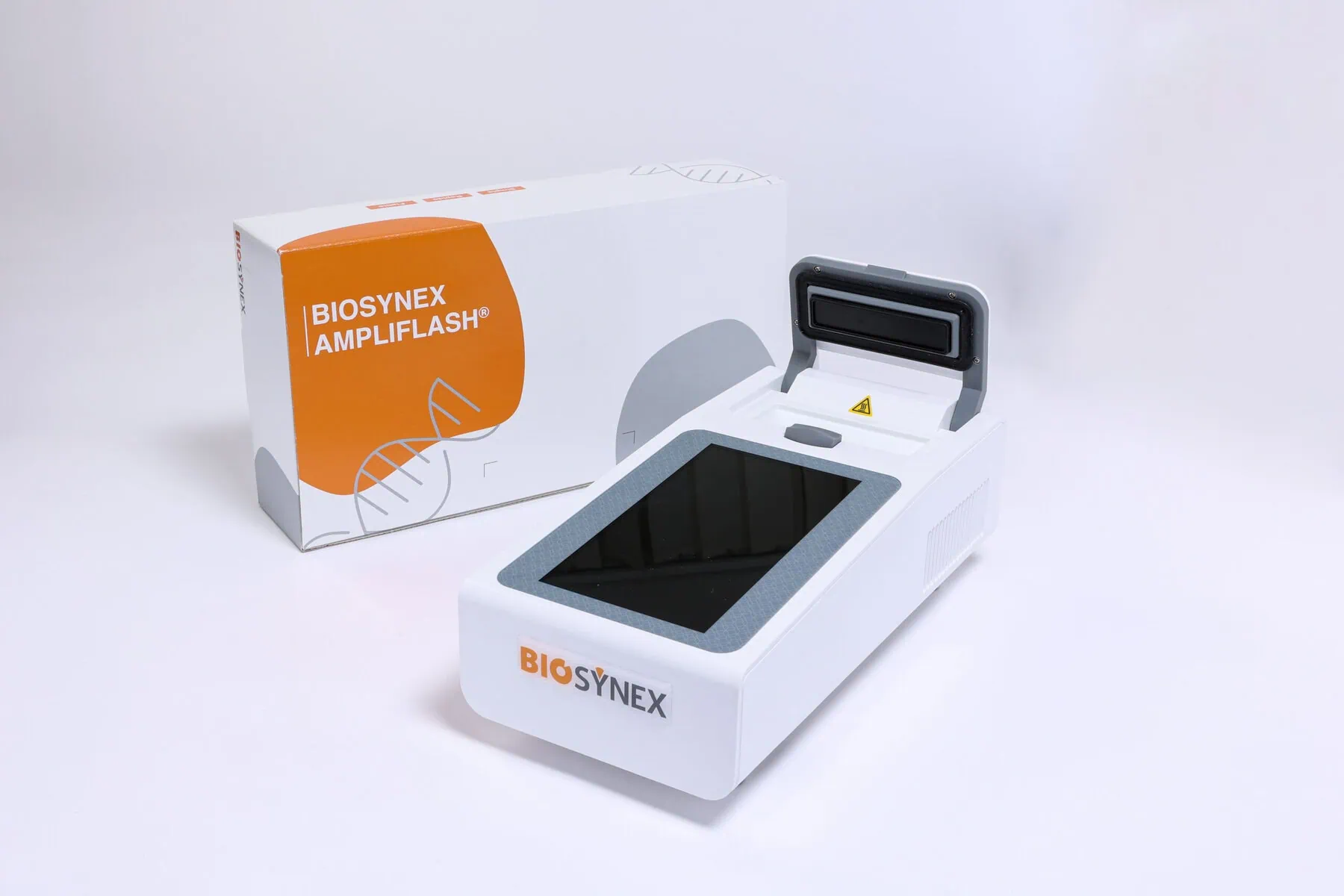
The Ampliflash® Malaria kit is built around Malaria LAMP isothermal amplification technology. Each kit contains 24 single-use strip assemblies, each composed of three reagent-filled microtubes and one orientation well marked by a red bead. Tubes include target-specific mixes for PAN (Plasmodium spp.), FALCI (P. falciparum), and an internal RNase P control, supporting simultaneous amplification of multiple sequences.
Accompanying the strips are activation buffer tubes, positive and negative controls, and cap strips. All reagents are stored frozen until use and remain stable up to their expiration date when kept at −20°C. A separate BIOSYNEX Blood Lysis kit enables rapid sample processing for whole blood collected in EDTA or heparin tubes. Together, these components provide a complete, reagent-ready workflow tailored for real-time isothermal detection.
Malaria is primarily caused by five human-pathogenic Plasmodium species, with P. falciparum responsible for most severe and fatal infections worldwide. Identifying P. falciparum rapidly is essential since clinical management and urgency differ significantly from infections caused by P. vivax, P. ovale, P. malariae, and P. knowlesi.
The PAN target detects a conserved mitochondrial cox gene sequence present across all Plasmodium species, enabling broad screening. The FALCI target, by contrast, amplifies a P. falciparum-specific cox gene region, supporting species-level discrimination crucial for clinical management.
The internal control (RNase P) verifies the efficiency of lysis and amplification, ensuring invalid samples—including those with inhibitors or insufficient nucleic acid—are flagged automatically. By combining these elements in a single Malaria LAMP run, the kit strengthens diagnostic accuracy and helps laboratories support early intervention.
The Ampliflash® Malaria kit uses a real-time isothermal LAMP process to deliver rapid malaria detection with minimal equipment needs beyond the Ampliflash Reader. Results appear within 3–25 minutes depending on parasitemia levels, and the system supports a full turnaround time well under two hours, aligning with global recommendations for rapid diagnostic workflows.
The kit has undergone performance evaluations demonstrating high analytical sensitivity, with limits of detection around 3 copies per reaction for both PAN and FALCI targets. Extensive cross-reactivity testing across >140 non-Plasmodium organisms showed no false positives, reinforcing assay specificity. Precision studies confirm reproducibility across operators, lots, and laboratories.
This robust performance makes Ampliflash® Malaria a reliable frontline tool for molecular malaria diagnosis in clinical laboratories, especially when smear microscopy is inconclusive or rapid confirmation is required.
The assay workflow starts with rapid sample preparation using the BIOSYNEX Blood Lysis kit: mixing 5 µL of whole blood with lysis and stabilization buffers, requiring only a few minutes at room temperature. Ten microliters of the resulting lysate are then combined with activation buffer, forming a ready-to-load reaction mix.
This mix is distributed into the PAN, FALCI, and internal control wells. After capping and inserting the strip into the Ampliflash Reader, the instrument maintains a constant 65°C environment for isothermal amplification. Fluorescence signals are monitored in real time, and the reader automatically interprets each well as positive or negative.
A valid run requires negative amplification in the FALCI and PAN wells of the negative control, and positive amplification in all wells of the positive control. The internal RNase P signal ensures sample integrity; any absence of RNase P signal, combined with negative target results, triggers an invalid result.
Early, accurate malaria diagnosis is vital for preventing complications and reducing mortality. The Ampliflash® Malaria Malaria LAMP assay supports clinical decision-making in emergency departments, travel clinics, infectious disease units, and microbiology laboratories.
By distinguishing falciparum from non-falciparum infections in under 30 minutes, clinicians can initiate appropriate treatment quickly—especially important in regions where imported malaria is frequently encountered.
The kit’s high sensitivity enables detection of low parasitemia, making it suitable for early-stage infections, partially treated patients, and cases where microscopy may miss low-density parasites. It also offers an objective, reproducible readout that reduces operator dependency.
With strong performance data across multiple international studies and compliance with WHO recommendations for rapid diagnosis, Ampliflash® Malaria strengthens laboratory capability and improves patient outcomes.