
SepsiTest™-UMD Kit
SepsiTest-UMD detects and identifies bacteria and fungi in primary sterile material by universal rDNA PCR followed by Sanger sequencing. The MolYsis pre-treatment depletes human DNA first, which is what keeps the universal primers from being swamped by host background. The assay amplifies the V3/V4 region of the bacterial 16S rRNA gene and the V8/V9 region of the fungal 18S rRNA gene. More than 345 species are detectable, of which more than 200 have been sequence-identified with this technology.
Quote-based, no public pricing. Add to your quote and our specialists put together a proposal with the right documentation, typically within 24 hours.
This kit in detail
- Universal 16S (V3/V4) and 18S (V8/V9) PCR with identification by sequencing
- More than 345 species detectable, over 200 sequence-identified
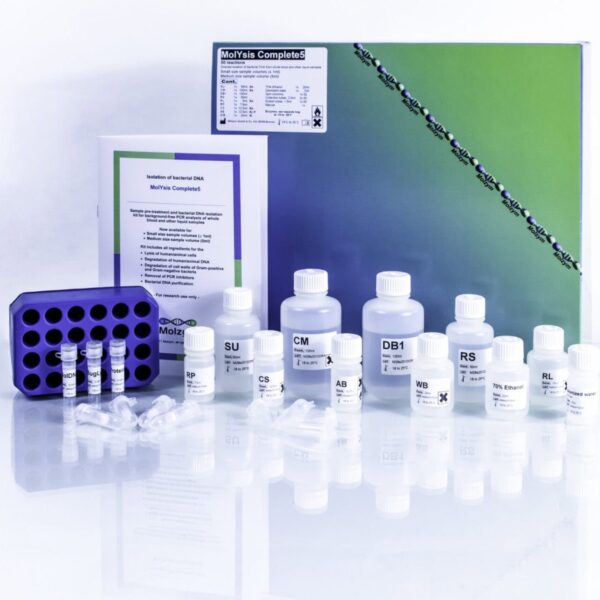
- MolYsis depletion of human DNA before extraction
- Detection from 10 cfu/ml for Candida, 20 cfu/ml for S. aureus
- Blood, body fluids, swabs and tissue; 1 ml per sample
- 24 or 48 preparations per kit, REF U-010-024 and U-010-048
SepsiTest-UMD detects and identifies bacteria and fungi in primary sterile material without culture. The kit combines sample pre-treatment, DNA isolation, universal rDNA PCR and sequencing-based identification.
Principle
The MolYsis pre-treatment lyses the human cells and degrades the released human DNA, so the enriched microbial DNA reaches the PCR with a much lower host background; that suppresses false results from non-specific primer binding. Universal primers then amplify the V3/V4 region of the bacterial 16S rRNA gene and the V8/V9 region of the fungal 18S rRNA gene. The amplicons are sequenced with the supplied primers SeqGP16, SeqGN16 and SeqYeast18, and the sequences identified by BLAST.
Sensitivity
The minimum titres reported are 10 cfu/ml for Candida albicans and Candida glabrata, 20 cfu/ml for Staphylococcus aureus, Staphylococcus epidermidis and Enterococcus faecalis, 40 cfu/ml for Escherichia coli, 50 cfu/ml for Klebsiella pneumoniae and Moraxella catarrhalis, 75 cfu/ml for Streptococcus pneumoniae and 80 cfu/ml for Pseudomonas aeruginosa.
Sample material and instruments
Body fluids including ascites, bronchoalveolar lavage, blood, blood culture, cerebrospinal fluid, plasma, pleural fluid, pus and synovial fluid; swabs from mouth, nasopharynx, wounds and bone; and tissue such as abscess material, biopsies, heart valves and prostheses. One millilitre is used for fluids and swabs, and tissue pieces of at most 0.5 by 0.5 by 0.5 cm. The end-point PCR protocol is validated on the Eppendorf Mastercycler, and real-time protocols on the Roche LightCycler 96, 480 and Nano, the Bio-Rad Opticon and CFX96, the Applied Biosystems 7500 Fast, the Stratagene Mx3000P and Mx3005P, the Qiagen Rotor-Gene and the peqSTAR 96Q.
Controls and limitations
The kit contains a Control DNA as internal extraction control, which monitors extraction, DNA quality and the absence of PCR inhibitors, plus positive PCR controls at two concentrations. Frozen and thawed specimens are not suitable, and the kit is not to be used for safety level 3 or 4 pathogens. The manufacturer states that sequencing results must be assessed by a clinician, to exclude contamination and organisms without clinical relevance. The device is CE-marked under Directive 98/79/EC and continues to be placed on the market under the transitional provisions of Regulation (EU) 2017/746.
- Lysis Buffer: A solution containing chaotropic salts and detergents that disrupt the red blood cells and release the microbial DNA into solution.
- Magnetic Beads: Beads coated with specific oligonucleotide probes that capture and isolate microbial DNA from the sample.
- Wash Buffer: A solution used to wash the magnetic beads and remove any remaining contaminants.
- Elution Buffer: A solution used to release the captured microbial DNA from the magnetic beads.
- Control DNA: A synthetic DNA that is added to the sample as an internal control to ensure that the assay is working correctly.
- PCR Master Mix: A solution containing all of the reagents necessary for PCR amplification of the captured microbial DNA.
- DNA Size Marker: A DNA ladder used to determine the size of the amplified PCR products.
- PCR Primers: Specific primers that amplify conserved regions of the microbial DNA for detection.
- PCR Enzyme: A heat-stable DNA polymerase enzyme used to catalyze the PCR reaction.
- DNase/RNase-free Water: Water that has been treated to remove contaminating DNases and RNases, which can degrade the extracted DNA.
The kit also includes instructions for use, as well as a protocol for the detection of microbial DNA in blood samples using real-time PCR.
Datasheets and regulatory documentation
Everything your quality team needs for evaluation and procurement.
Instructions for Use
Brochure
Frequently paired with this kit
Other assays and instruments lab teams add alongside the SepsiTest™-UMD Kit.


Add this kit to your quote
Tell us the platforms and throughput you’re planning for and our specialists will put together a clear proposal with the right documentation, no public pricing, just a considered answer.
